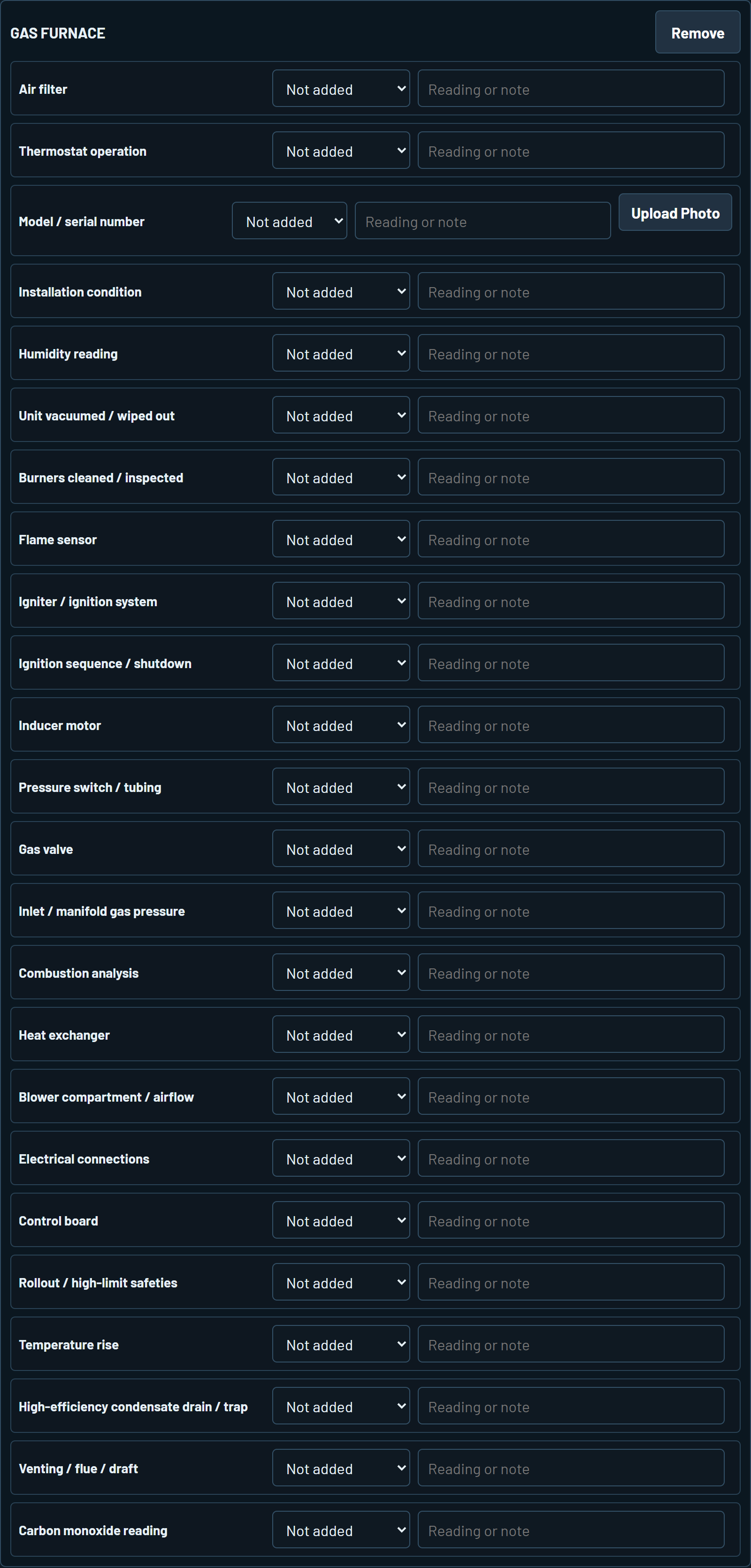
Tech Gibberish's gas furnace checklist provides 24 fields for recording equipment details, completed work, condition checks and readings. This page lists those fields in text, then shows how 20 recorded selections from a published visit became a customer report.
Use this as a documentation aid for qualified HVAC service personnel. Follow the equipment manufacturer's instructions, applicable requirements and your company's procedures. This page is not a service procedure, a complete inspection standard or a certification that equipment is safe. Review every report before sharing it.
The 24 checklist fields
The following labels match the existing gas furnace checklist. Record the actual result and any relevant reading or note for each applicable item. A listed field does not mean that work has been completed.
- Air filter
- Thermostat operation
- Model / serial number
- Installation condition
- Humidity reading
- Unit vacuumed / wiped out
- Burners cleaned / inspected
- Flame sensor
- Igniter / ignition system
- Ignition sequence / shutdown
- Inducer motor
- Pressure switch / tubing
- Gas valve
- Inlet / manifold gas pressure
- Combustion analysis
- Heat exchanger
- Blower compartment / airflow
- Electrical connections
- Control board
- Rollout / high-limit safeties
- Temperature rise
- High-efficiency condensate drain / trap
- Venting / flue / draft
- Carbon monoxide reading
View the existing gas furnace checklist image.
Record what each result means
Make the difference between a condition and an action clear in the visit record:
- Checked: identify what was checked and the observed result
- Cleaned or replaced: record the work actually completed
- Needs attention: describe the finding and recorded recommendation
- Not checked: say what was not checked and why, when known
- Not applicable: explain why the item does not apply when that distinction matters
- Missing information: keep it unresolved until it can be verified
The blank checklist image uses “Not added.” Treat an unfilled field as missing documentation. It does not, by itself, tell you whether an item passed, failed, was skipped or did not apply.
When readings are recorded, include their units and enough context to associate them with the right equipment and check. Use the applicable manufacturer or approved procedure for interpretation. Do not insert typical readings or assumed limits to make a report look complete.
A completed visit example
Original technician note
“Furnace maintenance”
Recorded selections
The published visit supplies these 20 selections:
- Air filter: Replaced
- Thermostat operation: Good
- Installation condition: Good
- Unit vacuumed / wiped out: Wiped out
- Burners cleaned / inspected: Good
- Flame sensor: Cleaned
- Igniter / ignition system: Good
- Ignition sequence / shutdown: Good
- Inducer motor: Good
- Pressure switch / tubing: Good
- Gas valve: Good
- Inlet / manifold gas pressure: Good
- Combustion analysis: Good
- Heat exchanger: Good
- Blower compartment / airflow: Good
- Electrical connections: Good
- Rollout / high-limit safeties: Good
- High-efficiency condensate drain / trap: Good
- Venting / flue / draft: Good
- Carbon monoxide reading: Good
What this example does not supply
The published selection list does not include model / serial number, humidity reading, control board or temperature rise. It also does not supply numeric readings for the items marked Good. Their absence is a limit of the published record; it is not evidence of a particular result or proof that a task was or was not performed.
The report should stay within the recorded selections. For example, “Burners cleaned / inspected: Good” should not become a claim that the burners were cleaned.
The customer report
The following technical sections reproduce the published customer report. The personal closing and review request are omitted.
Equipment
- Gas furnace.
Service performed
- Performed furnace maintenance.
- Replaced the air filter.
- Wiped out the furnace.
- Cleaned the flame sensor.
What is working properly
- Thermostat operation and installation condition were checked with no concerns noted.
- Burners, igniter / ignition system, and ignition sequence / shutdown were checked with no concerns noted.
- Inducer motor and pressure switch / tubing were checked with no concerns noted.
- Gas valve and inlet / manifold gas pressure were checked with no concerns noted.
- Combustion analysis, heat exchanger, and carbon monoxide reading were checked with no concerns noted.
- Blower compartment / airflow and electrical connections were checked with no concerns noted.
- Rollout / high-limit safeties and venting / flue / draft were checked with no concerns noted.
- High-efficiency condensate drain / trap was checked with no concerns noted.
Review the finished record
Before sharing a furnace maintenance report:
- Confirm that the correct equipment and visit are identified
- Match each completed-work statement to the technician's recorded action
- Check that condition statements reflect the actual selections and notes
- Verify readings and units without filling gaps from assumptions
- Keep findings, recommendations, pending work and customer decisions distinct
- Resolve anything ambiguous through the service record or responsible technician
A structured report can make the recorded work easier to understand. Its accuracy still depends on the visit information and the person reviewing it.
From checklist to customer write-up
Tech Gibberish brings your voice or typed notes and equipment checklist together in a structured report. Review the draft, then copy it into your existing invoice or work order.
See the Tech Gibberish workflow.
Related examples: